Showing posts with label supermacro. Show all posts

Tuesday, 21 January 2014

Replacement for Fuji X10


Flowers of Burdekin Plum. Fuji X10, Supermacro mode

I've got Fuji X10 long time ago, shortly after it  became available in Australia. The camera was used fairly extensively, and it started to show some signs of wear and tear. It lost a rubber thingy at the back, which is not surprising considering the local climate with temperature over 40 C. It freezes occasionally, which is again, not surprising considering the local humidity. But it seems that our 'orb generator' will not survive for very long. I hope it would last till release of rumored X30....

I often use Fuji X10 in supermacro mode, or macro at long end. The quality is good enough for my needs. The XF60mm macro lens can produce a stunning images but the autofocus (speed) on early versions of the X-E1 firmware was not very impressive. The latest firmware adds a very nice manual focus assist option but I don't have the macro lens. On other hand, it turned out that XF55-200mm is very handy for modest close-up shots. The magnification is ok, and 200mm is not very obtrusive for various bugs.  Obviously, 200mm provide some extra reach, which is handy for shooting distant objects such as flowers on trees etc.


Blue Triangle Butterfly. Fuji X-E1 & XF55-200mm (crop)

Tuesday, 15 January 2013

Macro

Spider
Fuji X10, supermacro, aperture priority, 12MP, iso 200, 1/900 sec, F2.8, exposure compensation -0.3. 
GIMP: levels, crop, resize, local unsharpen mask 

For me one of the most attractive features of advanced compact cameras is supermacro mode. Because of small sensor and wide angle the depth of field is enormous on compact cameras. Unfortunately, all current (serious) compact cameras have supermacro mode at wide end of the zoom. It does help with DoF but the distance between lens and the object is very small. It is OK for flowers but with bugs it is complicated. The "last year" models of advanced compact cameras  are cheaper than dedicated macro lenses for most DSLRs or mirrorless cameras. Plus no need to change lens every time I want to shoot macro.

Nikon 1 system probably also would have enough DoF but unfortunately, the dedicated macro lens is not yet available. Probably AF-S DX Micro Nikkor 40mm F2.8 with FT1 adapter can be a viable solution but the whole set will be big, heavy and definitely more expensive than enthusiast compact cameras. Obviously, for someone with a collection of Nikon lenses the situation might be different. I don't have any Nikon glass.

Thursday, 28 June 2012

The best digital camera

Red hibiscus: stigma

Supermacro on Fuji X10, crop and some editing in GIMP

The best digital camera is the camera you use to take pictures and enjoy it. Many of my favorite pictures were taken with 2MP camera. This old point-and-shoot camera would not much my current DSLR in image quality but I took more pictures with it. In last several months I took 5-6 times more pictures with the Fuji X10 than with my DSLR. The Fuji X10 is a "family camera", so I cannot take it with me every day. Image quality of Fuji X10 is sufficient for my needs. It does make me happy.

Take the image of the Hibiscus stigma posted above. It was edited in GIMP to greater extend that I normally do. It was taken with Fuji X10 at iso 400, F4.0, 1/56 sec, compensation -0.3 EV. I posted 100% crop from the original JPEG below. There are several problems with this image. Red channel was oversaturated and clipped to some extend, and I would like see more details in tiny hairs on the stigma. In order to take similar picture with a DSLR I need to buy macro lens and carry it together with zoom lens, while Fuji X10 fits into a small camera bag.

It also turned out that I am getting more sharp images with the Fuji X10 than with my DSLR. I suspect the mirror slap. It can be resolved with a tripod but it would add a couple kilos to my bag.

I really enjoy depth of field in Fuji X10: the image above was shot on cloudy day at F4.0, and to get the same depth of field on a DSLR I need to close the aperture for several stops.

Would I choose Fuji X10 over my old 2MP point-and-shoot? For sure. Would I damp my DSLR and use only Fuji X10? Probably not because I like the image quality of Olympus DSLRs, and occasionally I like to have a narrow DoF. Do I want to upgrade the Fuji X10 to another compact camera? I may buy another compact camera because I want to have camera with me every day but I am not in a hurry. I will wait for replacement of current high end compacts because I am very intrigued by 1' sensor in Sony RX100. Cameras with 1' censor still have relatively big depth of field but the image quality should be similar to what we see in current advanced compacts or even better due to improvements in the sensor technology. Olympus XZ-2 with 1' sensor and bright lens will be very tempting especially with the screen used in Olympus OM-D E-M5 (one of my complains about the X10 is the fixed screen). Samsung EX2 might be also interesting camera.

While I am not really happy with my DSLR I do not want to buy another big camera. I'd rather buy a mirrorless system camera. Frankly, the only major advantage of mirrrorless system cameras over DSLRs is a smaller size, but I would prefer to have a smaller camera with smaller lenses. The gap between mirrorless and DSLR cameras will narrow in the future to the extend when the difference will be irrelevant for practical use in 95% of situations. Nikon already demonstrated fast and accurate focus in their Nikon 1 cameras. The battery life probably can be improved to some extend.


Sunday, 6 May 2012

Supermacro with Fuji X10

Fuji X10, f4, iso 200, 1/160 sec | Toowong, May 5, 2012

The plant resembles a cultivar of Cordyline fruticosa, Ti Plant, from Asparagaceae family. I've posted another macro on the flickr. The levels were adjusted, the image was cropped and resized in GIMP, plus local unsharpen mask. The whole processing took a couple minutes. At the bottom is unmodified 100% crop from the original JPEG.

Our Fuji X10 had over 4,500 activations now. For comparison, on Olympus E-30 I made just over 10k activations since 2009. The E-30 is capable camera but I just don't like it. It is big and heavy. I can leave Fuji X10 in my backpack and wouldn't even notice it. It is really handy to have a camera with you. The image quality of pictures from Fuji X10 is sufficient for my needs. The only camera I'll buy immediately would be "updated" Fuji X10 with tiltable (not fixed) screen and supermacro implemented on long end of the zoom. I don't care about a viewfinder but would prefer EVF over OVF. If the lens will get an extra reach (e.g. 140mm) I would not mind to get a bulkier body. 

Unedited crop from the original image

Sunday, 1 April 2012

Dragonfly with Fuji X10

Dragonfly | Fuji X10 | Bowen park, Herston, March 30, 2012

The picture was taken with Fuji X10 in Aperture priority / Supermacro mode, and at some point I pushed the dragonfly's wing with the lens. It is hard to take pictures of flying insects at 28mm :). I had step-up ring and UV filter mounted on the camera, and the filter goes very close in supermacro shooting. It was very lazy afternoon, and the dragonfly was very calm. We had two photo sessions: the first ended when I touched the wing with the lens, and in second the insect was upset at some point with the camera above it.

Tech: iso 200, F7.1, 1/90 sec. As usual, I used a spot metering. The image above was cropped in GIMP. Below is 100% crop from OOC JPEG.


I guess it is one of the most common medium-sized dragonflies in Brisbane but I cannot identify it in Wildlife of Greater Brisbane.

There were quite a few rains this March in Brisbane, so the insects are numerous and ubiquitous :)  It is very different from previous years of drought when main color of landscape was yellow. Now everything is green. 


100% crop from unedited OOC JPEG

Friday, 30 March 2012

Butterfly with Fuji X10

Euploea core | Bowen park, Herston, March 30, 2012 |  flickr

Common Crow, Euploea core sitting on dry fruit(?) of Canna lily. Fuji X10, supermacro / aperture priority mode, iso 100, F4.5, 1/120 sec. Cropped and resized in GIMP, and unsharpen mask was applied locally. The unedited 100% crop from the original JPEG is posted below.

I bet people who created this camera do not take picture of flying insects. Otherwise it is hard to explain why the premium compact has macro at 28mm (35mm eqv). It is hard to get very close to insects, and at short distance lens shade becomes an issue. I wish the camera would have supermacro implemented on the long end of zoom, or at least around 50mm (equivalent).

Unedited 100% crop from the OOC JPEG

Monday, 12 March 2012

bugs with Fujifilm X10

Nymph of Hedge grasshopper, Valanga irregularis | Fuji X10 | Toowong, March 12, 2012 | flickr

I planned to take a close-up picture of flowers of Fijian Fire plant, Acalypha wilkesiana, but it was windy. The flowers of this plant are very small, so even the slightest movement will have strong impact on image. Anyway, I spotted this nymph and took few pictures. I was somewhat surprised that the insect allowed me to move the camera so close (the shadow of the lens is visible in all shots). Than I noticed a new object on the leaf that was not there when I started to take pictures... And insect have gone shortly after that :)

The pictures were taken with Fuji X10 in Aperture priority/Supermacro mode at iso 100, F5.6, and exposure around 1/400 with spot metering. The images were cropped in GIMP with subsequent unsharpen mask. The unedited 100% crop from the first image is posted below.

It seems that majority of my pictures with Fuji X10 were taken in Supermacro mode. I don't have macro lens for Olympus DSLR, and while the lens I have can focus relatively close it cannot compete with the Supermacro mode on the Fuji X10.

Wednesday, 22 February 2012

Traditional lunch walk with the Fuji X10

Young leaves | Herston, February 20, 2012 | flickr

The Fuji X10 is a quite unusual camera. People have very polarized opinions on it. Some are very happy with the pictures from the camera while others are extremely dissatisfied. I bet members on both sides would be happy not to have the sensor blooming issue but for many people the orbs do not create problems. Here I am talking about my personal experience, and I would like to repeat that many people are genuinely unhappy with the orbs in their images. Because majority of my pictures taken with the X10 do not have orbs, I am very pleased with the camera. In last few months I took more images with the X10 than with Olympus E-30. I really like colors in OOX JPEGs from the X10, and the size and weight of the X10 are the obvious advantages over DSLR. In most situations the quality of images from X10 is very good for me. For the web or monitor 12MP are more than enough.

I do prefer the quality of images from the X100 (it is just in different league) but the X100 costs twice as much. I bought the X10 as a family camera, and for us it suits this role better than the X100 (video, zoom). And I am scared by sticky blades problem in the X100....

As for pictures... On the top, I guess it is Syzygium sp, from Myrtaceae family. EXIF: iso 100, 1/100 sec, F2.5, 17.3mm, resized in GIMP + unsharpen mask.


Callistemon | Herston, February 20, 2012 | flickr

The Callistemon picture was taken at iso 200 (accidentally) 1/1100 sec, F5.6, Supermacro mode. 

Grevillea | Herston, February 20, 2012 | flickr
ISO 100, 1/1700 sec, F4.0, Supermacro mode. It was windy.
I usually use spot metering with exposure compensation if needed and central focal point.

Wednesday, 8 February 2012

My best supermacro with Fuji X10

Forktail damselfly, Ischnura sp | Herston, Brisbane, February 8, 2012 | flickr

I am not really happy with the implementation of supermacro mode on Fuji X10 because in order to get decent magnification the camera should be positioned very close to the object. It is not a big issue with flowers and other inactive objects but with insects it is a big problem. It can be done, as you can see, but it is somewhat complicated. I was lucky today with the weather (early afternoon, just before the rain), and the damselfly apparently was not in a flying mood. Shot with Fuji X10 in Supermacro mode / Aperture priority, F4.5, iso 100, 1/180 sec. I also used a reduced focusing area. I generally use a single spot focusing and spot metering, and on Fuji X10 the size of the focusing spot can be changed by user. I am not sure if this change also affects the metering but it seems that it does improve focusing in macro mode.

The image above was rotated, cropped and resized in GIMP, and unsharpen mask was applied for final picture. Below is unedited 100% crop from the original JPEG. Click on the images to see a bigger picture.

Unedited 100% crop from the original OOC JPEG

Tuesday, 7 February 2012

Tussock Moth caterpillar after molting

Tussock Moth caterpillar | Brisbane, February 4, 2012 | flickr

We have a tiny blackbean (Moreton bay chestnat) tree growing in a pot on our balcony. Under one leaf we found what I identified as the Tussock Moth caterpillar just after molting. Because insects and their larvae have external skeleton they need to change it (molt)  in order to grow. Caterpillar eats a lot, than it molds and makes a new skeleton, which is bigger than the old one. So, it grows only immediately after molting, when a new skeleton is still elastic/not hard. On the photo above the old "skin" is on the left, and it is visibly smaller than the new caterpillar. Two white "cords" on the old "skin" apparently correspond to remnants of the nerve system. I was surprised to see the difference in color between larvae stages (different caterpillars). The caterpillar was on lower side of the leaf, and I bent it to get a better light.

The picture was taken with Fuji X10 in Supermacro mode, F7.1, iso 200, 1/120 sec. The image was cropped in GIMP. Below is unedited 100% crop from the original image. Click on images to see the bigger picture.

Sunday, 5 February 2012

Supermacro on Fujifilm X10


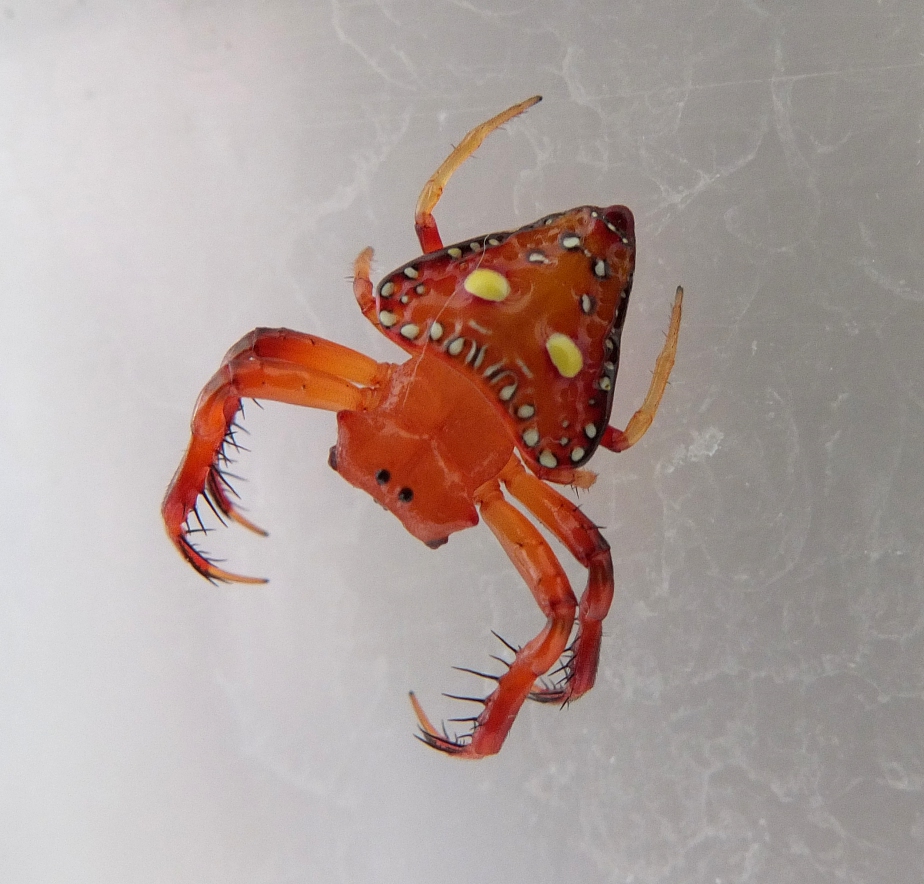
Yep, that is how I use supermacro mode on Fuji X10. Why camera makers insist on putting Supermacro mode on wide angle? The Triangular spider, Arkys lancearius, is not dangerous, and it's bite may cause just mild local pain, so I don't mind to work at short distance.

All images below were cropped and edited in GIMP. The last image was posted just to give an idea about spider's size.


Sunday, 22 January 2012

Fuji X10: macro at iso 800

Beehive Ginger, Zingiber spectabile, Roma street parkland, Brisbane. January 9, 2012

Hanheld shot in supermacro mode on Fuji X10. The position was very uncomfortable for shooting, and it was windy, so I used iso 800. It was possible to use a lower iso because the shutter speed was 1/800 sec. Other tech for this shot: F3.2, supermacro mode, 12 megapixels mode, noise reduction low. The original OOC was cropped in GIMP, and the unsharpen mask was applied to the flower. Unedited 100% crops from the original image are at the bottom of this post.

My first digital camera, Olympus C2020, had maximum iso 400, maximum shutter speed of 1/800 sec, and just 2 megapixels. It was able to take 320x240 movies at 15 fps. The lens was bright, 2.0-2.8, and it had on optical viewfinder, very much like the Fuji X10. By memory, the price was double of the Fuji X10...

 100% crop from the original JPEG

 100% crop from the original JPEG

Tuesday, 17 January 2012

Portuguese Man o' War

Portuguese Man of War, Alexandra Headland. January 14, 2012.
Portuguese Man o' War, or Blue Bottle, Physalia physalis, on rock on Alexandra Headland, between Mooloolaba and Maroochydore. Very often people call these creatures "jellyfish" but in fact it is a colony made of several types of different organisms. It has a "balloon" filled with gas to stay on the surface of the water and tentacles up to to 50 meters long. The colony use the tentacles to catch small fish. The tentacles are equipped with stinging cells which venom can paralyze a pray. People are also sensitive to the venom. 

Physalia cannot swim but float passively, and occasionally can be thrown on shore by wind or waves as on the picture. 

The photo was taken on cloudy day with Fuji X10 as a medium resolution JPEG, F7.1, iso 200, exposure compensation -1.0, 1/75 sec, supermacro mode, handheld. The different types of polyps are visible on 100% crop below. I included the biggest clipped highlight area on this crop in order to illustrate the absence of orbs on natural objects.

Another blue bottle picture is on my flickr page.